
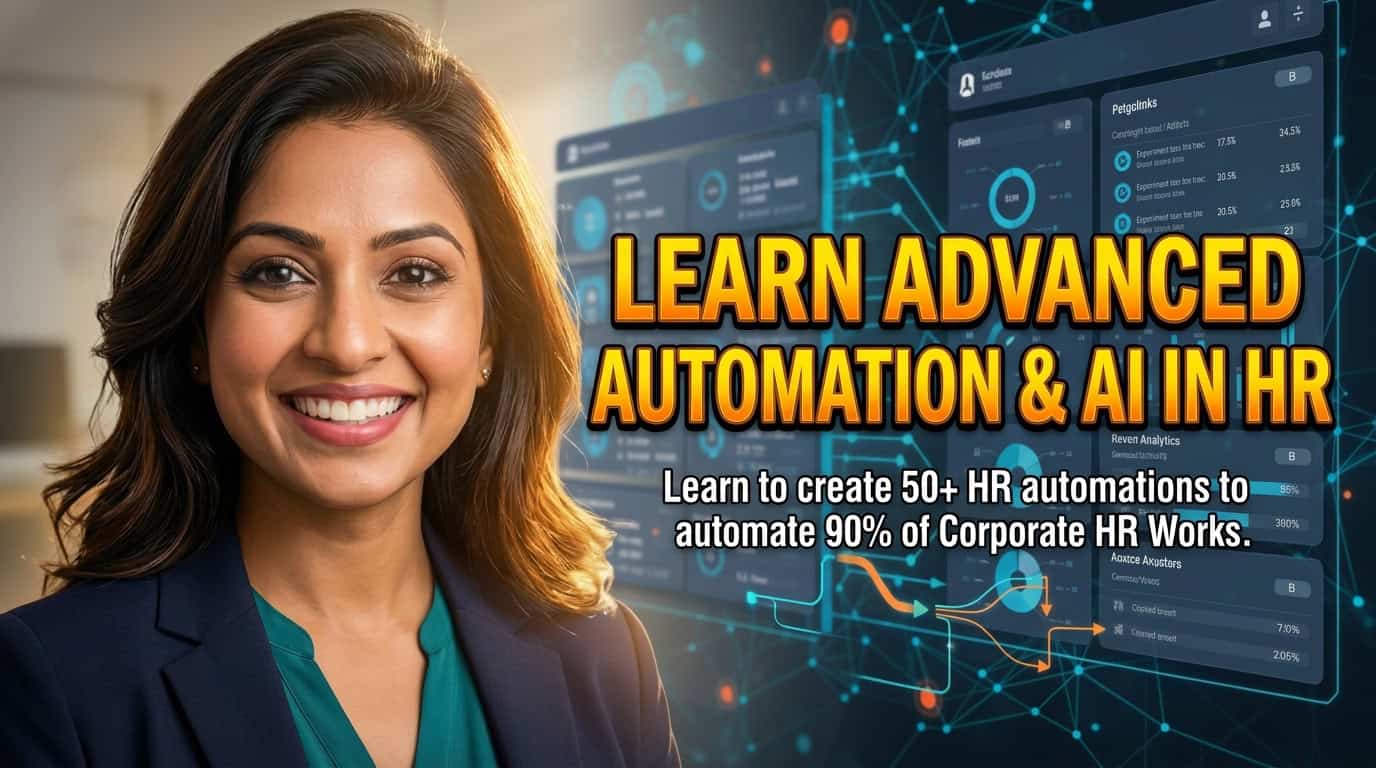
AI Course for HR Professionals: AI & HR Automation Training in the I-CGHR
An AI course for HR professionals teaches you to use AI and automation tools inside everyday HR work — drafting letters and job descriptions, screening applications, moving candidate data between systems, generating reports — so that repetitive tasks run themselves and your time goes to the people part of the job. At IHRA, AI & automation for HR is one of the 22+ software areas taught inside the 4-month I-CGHR programme: over 50 AI automations covering roughly 90% of real-world corporate HR tasks, alongside 60+ HR modules and a 100% Placement Guarantee. It is applied AI for HR work, not a programming or machine-learning course.
IHRA is an Advanced HR Training Institute with International Certification, based in Koramangala, Bengaluru, with Live Online classes for candidates anywhere in India. This page explains what “AI for HR” means in practice, what you actually learn in the AI and automation part of the programme, who it suits, and how it sits inside the wider I-CGHR — so you can decide whether it is the right kind of AI training for the HR career you want.
See the full I-CGHR syllabus, the 22+ software tools and how the AI for HR module fits in.
What Does “AI for HR” Actually Mean?
Strip away the hype and “AI for HR” comes down to two things. First, using AI tools to do the writing, sorting and summarising that used to eat an HR executive’s afternoon — a first draft of an offer letter, a shortlist from two hundred applications, a summary of exit-interview comments. Second, using automation to connect the systems HR already runs on, so that a candidate accepted in the ATS appears in the HRIS, receives the right documents and gets a welcome email without anyone copying and pasting between screens.
Neither of those requires you to build the AI. The tools exist; most of them sit inside HR software you would use anyway. What employers are now asking for is an HR professional who knows which tool fits which task, can set up the workflow, and can check the output before it goes to an employee. That is what an AI course for HR professionals should teach, and it is what IHRA’s AI & automation module is built around.
It is worth being clear about what it is not. It is not a course in Python, data science or machine-learning theory. If you want to build AI models, look at a technical programme. If you want to run an HR function with AI doing the repetitive work, this is the right kind of training.
What You Learn in the AI & Automation for HR Module
The module sits inside the software half of the I-CGHR, next to Workday HCM, SAP HCM / SuccessFactors, Oracle HRMS, HRIS and payroll software, ATS and PMS tools. It is taught hands-on, in the tools, rather than as a slide deck about the future of work. Across the module you work through over 50 AI automations, chosen because together they cover roughly 90% of the real-world tasks a corporate HR team handles. Broadly, they fall into three groups:
1. Automating repetitive HR tasks
Identifying the tasks that repeat every week — data entry, document generation, follow-up emails, status updates — and building workflows that run them with a trigger instead of a person. Onboarding is the classic example: a completed joining form feeding the HRIS, the employee database, an appointment letter and a welcome email in one chain.
2. Using AI tools inside HR software
Using AI features where they already live — drafting job descriptions and HR letters, screening and ranking applications in an ATS, summarising survey and feedback data, preparing reports and dashboards — and learning where to check the output before it reaches an employee or a manager.
3. AI in your own job search
Every enrolled student gets free access to IHRA’s AI-powered, ATS-friendly resume builder, used alongside CV building, LinkedIn profile building and interview preparation. You learn to get past the same screening software you will later operate as an HR professional.
The thread running through all three is judgement. An automation that generates an appointment letter with the wrong salary figure is worse than no automation. So the module spends as much time on where a workflow needs a human checkpoint as on how to wire it up — when to keep an editable version of a document, when to send a locked PDF, when a manager has to approve before the next step fires.
Is This a Coding or Machine-Learning Course?
No. You do not write code, train models or study algorithms. The AI & automation module is applied training: you work inside HR tools that already have AI and automation features, and you learn to configure them for real HR workflows. A candidate from a commerce, arts or science background with ordinary computer skills is the typical student. If you can use a spreadsheet and an email client, you have the starting point.
That distinction matters when you compare courses. A general AI or data-science programme will teach you a great deal that an HR role never uses, and nothing about PF filings, appraisal cycles or how an ATS is set up. An AI course for HR professionals goes the other way: narrow on the technology, wide on the HR work it is applied to.
Who Is an AI Course for HR Professionals For?
- Working HR professionals in recruitment, operations or admin roles who see the manual work piling up and want to be the person who automates it, not the person replaced by it.
- Freshers and recent graduates entering HR who want AI and automation skills on the CV from day one, because job descriptions for HR executive roles increasingly ask for them.
- Career switchers from operations, customer support, sales or teaching who already think in processes and want the HR-specific toolkit to go with that instinct.
- HR generalists at small companies who run everything themselves and have the most to gain from letting workflows handle the repetitive part.
If you are entirely new to HR, the AI module on its own will not get you a job — you need the functional knowledge it sits on top of. That is why IHRA teaches it inside a full generalist programme rather than as a standalone short course. Our HR generalist course page explains that foundation in detail.
AI Tools for HR: What the Category Covers
People searching for “AI tools for HR” usually want to know what kinds of tool exist and which ones are worth learning. The market changes month to month, so a named list ages fast. The categories do not. The ones you will meet in most Indian corporate HR teams are:
AI inside the ATS. Resume parsing, candidate ranking, screening questions and interview scheduling — the recruitment end of the lifecycle.
Drafting and document assistants. Job descriptions, offer and appointment letters, policy drafts, employee communications — generated from a template and your data, then reviewed by you.
Workflow automation. The connectors that move data between forms, spreadsheets, the HRIS, document generators and email so that a multi-step process runs from a single trigger.
Analytics and reporting. Dashboards, attrition and engagement analysis, survey summaries — where AI turns raw HR data into something a management meeting can act on.
Employee-facing assistants. Chat-style helpdesks that answer leave, policy and payslip questions so HR is not fielding the same query forty times a month.
IHRA’s programme approaches these through the HR software already in the syllabus — the ATS, HRIS, payroll, PMS and survey tools — plus dedicated AI and automation tools for HR. The aim is that when a new tool arrives at your employer, you recognise which category it belongs to and know how to put it to work.
How AI for HR Fits Inside the I-CGHR
The I-CGHR — Internationally Certified Generalist in Human Resource — is IHRA’s flagship 4-month certification. IHRA is internationally affiliated and accredited. The programme covers 60+ HR modules across recruitment, onboarding and operations, payroll and compensation, statutory compliance, performance management and employee relations, and 22+ HR software tools. AI & automation for HR is one of those software areas, taught after you understand the HR processes it automates.
- Foundation first. You learn how onboarding, payroll or appraisals actually run before you automate any of them. Automating a process you do not understand only makes mistakes faster.
- Tools together. The AI module draws on the ATS, HRIS and document work you have already done in the programme, so the workflows you build connect systems you know.
- Career support built in. MS Office 365 skills, interview preparation, CV and LinkedIn profile building and the free AI-powered ATS-friendly resume builder are scheduled inside the four months, ending in a 100% Placement Guarantee.
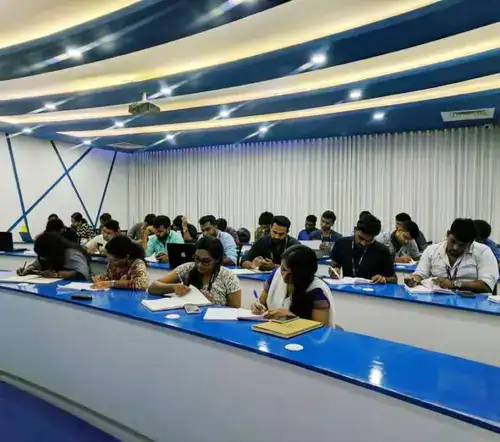
Both formats — classroom in Koramangala, Bengaluru, and Live Online for candidates across India — cover the same syllabus, including the AI & automation module. For the complete programme structure, see the I-CGHR programme page.
IHRA — International Human Resource Academy
1st Floor, Guru Plaza, Above TVS Motors, Sidharata Colony, Madiwala, Koramangala 2nd Block, Bengaluru, Karnataka 560068
Phone / WhatsApp: 9400785899
Email: ihrahelpline@gmail.com
Want AI and automation skills on an HR foundation that employers recognise? Start with the programme overview.
AI Course for HR Professionals: FAQs
What does “AI for HR” mean?
AI for HR means using AI and automation tools inside everyday HR work — drafting letters and job descriptions, screening applications, moving data between the ATS, HRIS and payroll systems, summarising surveys and generating reports — so repetitive tasks run automatically and HR time goes to people. At IHRA it is taught as one of the 22+ software areas in the 4-month I-CGHR programme.
Is this a coding or machine-learning course?
No. IHRA’s AI & automation for HR module is applied training within HR workflows. You do not write code or study algorithms; you use AI and automation features inside HR software to build workflows such as onboarding automation and document generation. Ordinary computer skills are enough to start.
Do I need a technical background to learn AI tools for HR?
No. Students come from commerce, arts, science and management backgrounds. If you can work in a spreadsheet and manage email, you have the starting point. The module is taught hands-on inside the tools, after you have learned the HR processes the tools automate.
Is AI for HR a separate course or part of the I-CGHR?
It is part of the I-CGHR. IHRA teaches AI & automation for HR as one of the 22+ software areas inside its 4-month, 60+ module generalist programme, not as a standalone short course, because automation skills are only useful on top of a working knowledge of the HR processes they automate.
Which AI tools for HR are covered?
The programme covers over 50 AI automations for HR, spanning roughly 90% of real-world corporate HR tasks, taught alongside its ATS, HRIS, payroll, PMS and survey software, plus an AI-powered ATS-friendly resume builder that enrolled students use free. Specific tools are updated as the market changes; contact IHRA admissions for the current list.
Does the AI course for HR professionals include placement?
Yes. The I-CGHR, which includes the AI & automation module, carries a 100% Placement Guarantee. Interview preparation, CV building, LinkedIn profile building and the AI-powered resume builder are all built into the four months.
Can I do the AI for HR training online?
Yes. IHRA runs the I-CGHR as Live Online classes for candidates across India and as classroom batches in Koramangala, Bengaluru. Both formats cover the same syllabus, including AI & automation for HR.
What salary can I expect after the program?
Salary ranges from around ₹40,000 to ₹1.5 lakh per month based on your profile — your qualification, prior experience, the role you move into and the employer you join.


